

Italy offers a balance that many people do not expect: lower daily costs, accessible healthcare and the possibility of working part-time while studying. But to make it work, you need a clear and realistic plan.
In this guide, you will learn:
- how much you need per month
- how costs change between cities such as Milan, Florence, and smaller towns
- what to expect for rent, food and daily expenses
- how much you can realistically earn with a part-time job
Cost of living in Italy: what to expect as an international student

Costs vary greatly depending on where and how you live, and especially on how you choose your accommodation. A student budget in Florence is not the same as in Milan, and sharing an apartment is very different from living alone.
In general, your monthly expenses will be built around a few main categories:
- rent, by far the most important expense
- utilities, such as electricity, gas and Internet
- food and groceries
- transport
- personal and social spending
Once you understand how these elements interact, it becomes much easier to estimate how much you will actually spend.
Is Italy really cheaper than the United States and the United Kingdom?
In most cases, Italy is more affordable than both the United States and the United Kingdom, but not always in the way you might expect.
Rent can be lower, especially outside Milan, but the biggest difference usually concerns everyday life costs such as transport, daily expenses and, above all, healthcare.
If you come from the United States, you are probably used to paying hundreds of dollars per month for insurance. In Italy, the situation is very different. As an international student, you can access the national healthcare system (SSN) by paying an annual fee, or you can choose a private insurance plan at a relatively low cost.
Beyond healthcare, everyday life is generally more affordable. Groceries tend to be cheaper, especially if you cook regularly. Public transport is accessible in most cities, with student discounts and monthly passes. Phone plans are also much cheaper than typical US or UK standards.
That said, Italy is not cheap in every respect. Rent will have the biggest impact on your total budget. In cities such as Milan and, to a lesser extent, Florence and Rome, rent can be high, especially if you want to live alone or in a central area.
How much do you need per month in Italy?
Now let’s get practical. Your monthly budget in Italy will mainly depend on:
- the city
- your housing situation, shared or private
- your lifestyle
As a general guideline, you can expect different ranges depending on where you live. In more affordable cities, especially in the South or in smaller towns, students often spend between €700 and €1,000 per month. In cities such as Florence, Rome or Bologna, a more realistic range is between €900 and €1,400. In Milan, Italy’s most expensive city, monthly costs can easily reach €1,200 to €1,800 or more.
These estimates usually include:
- rent, usually in shared accommodation
- utilities
- food
- transport
- basic personal expenses
Here is a simple overview:
| Type of city | Estimated monthly budget |
|---|---|
| More affordable cities, South and smaller towns | €700 – €1,000 |
| Medium-cost cities, Florence, Rome, Bologna | €900 – €1,400 |
| Expensive cities, Milan | €1,200 – €1,800+ |
The main point is that two students in the same city can have very different expenses. Sharing a room instead of renting a private apartment can reduce costs by several hundred euros per month. Cooking at home instead of eating out regularly can also make a significant difference over time.
That is why it is more useful to think in terms of choices, not just averages.
Rent in Italy: how much you will really pay
For most international students, rent will be by far the largest monthly expense. In many cases, it can take up 40% to 70% of your total budget.
The most important decision you will make is not just where you live, but how you live. In Italy, the difference between sharing a home and living alone is often more important than the difference between cities.
Types of accommodation and average prices
As an international student, you can usually choose between three main options:
- Shared room, or bed in a shared room: sharing a bedroom with another person. This is the cheapest option and is quite common in student cities.
- Single room in a shared apartment: having your own room while sharing the kitchen and bathroom. This is the most popular choice for international students.
- Studio or private apartment: living alone. This gives you full independence, but it is significantly more expensive.
| Type of accommodation | Average monthly cost |
|---|---|
| Shared room | €250 – €450 |
| Single room | €400 – €700 |
| Studio / private apartment | €700 – €1,200+ |
These averages can change a lot depending on the city. For example:
- in Milan, prices are often at the top of these ranges
- in Florence and Rome, you will usually be in the medium-high range
- in Bologna, prices are moderate, but demand is very high
- in Southern Italy, you can often find lower prices, especially outside the major cities
Another important point: in many listings, especially for rooms, utilities may or may not be included, so always check this carefully.
Other housing costs to consider
Rent is not the only housing cost you will face when moving to Italy. There are some additional expenses you should be prepared for:
- Deposit: usually equal to 1-3 months of rent, paid in advance and returned at the end of the contract.
- Agency fees, if applicable: if you rent through an agency, you may have to pay a one-time fee, often around one month’s rent.
- Utilities, if not included: electricity, gas, water and Internet can add around €50 – €150 per month, depending on the apartment, the season and the number of people you share it with.
Daily expenses in Italy: how much you will spend each month

Daily expenses are generally more manageable in Italy than in many other countries, but they depend heavily on your habits.
Food, transport and utilities
Food is one of the areas where you can save the most. If you cook regularly at home and shop in supermarkets or local markets, your monthly food budget can remain relatively low. Eating out is also more affordable than in the United States or the United Kingdom, but it can still increase your budget quickly if you do it often.
In general, transport is not a major expense, and in most student cities you will not really need a car. Cities such as Florence, Bologna and even some areas of Rome are designed to be walkable, and daily life often happens over short distances.
Public transport is widely available and relatively affordable. As a student, you can usually access:
- discounted monthly or annual passes, around €25 – €50 per month
- reduced fares for buses, trams and local trains
On the other hand, owning a car is usually unnecessary and expensive. You would have to pay for fuel and insurance, and in many city centers there are traffic restrictions, such as ZTL zones, that limit access.
Utilities, such as electricity, gas, water and Internet, can vary depending on the apartment and the season. Heating costs in winter can increase bills, especially in older buildings. If utilities are not included in the rent, you can usually expect to share these costs with your flatmates.
Healthcare and insurance
If you come from the United States, you are probably used to a system where healthcare is expensive, complex, and often unpredictable. In Italy, the situation is much more stable and accessible.
As an international student with a residence permit, you generally have two main options:
- you can register with the Italian national healthcare system, or SSN
- you can choose a private health insurance plan
With the public system, by paying an annual fee, usually between around €150 and €700, depending on your situation, you can access the national healthcare system. This includes:
- visits with a general practitioner
- hospital care
- emergency services
- many specialist services at low cost
Private insurance is also an option and is often required at the beginning for visa purposes. With private health insurance, instead of being part of the public system, you are covered by an insurance policy that reimburses medical expenses or gives you access to a network of private clinics.
Again, prices are generally much lower than in the United States, around €1,300 – €2,000 per year, and coverage is designed for students.
For many international students, this is an important factor in making life in Italy sustainable. It removes one of the biggest uncertainties from your budget and allows you to focus on your studies and on building your experience here.
Typical monthly budget for one person
| Expense | Typical price | Notes |
|---|---|---|
| Shared room | €250 – €500 | Cheapest option, common among students |
| Single room | €400 – €700 | Most popular choice for international students |
| Private apartment | €700 – €1,200+ | Much higher in Milan and central areas |
| Food and groceries | €250 – €400 | Lower if you cook regularly |
| Transport | €25 – €50 | Student discounts available; car not necessary in most cities |
| Utilities and Internet | €50 – €150 | Often shared with flatmates; higher in winter |
Which Italian cities are more affordable for students?
In Italy, the cost of living is not evenly distributed. Two main factors influence prices:
- geographical area, meaning North, Centre or South
- city size, meaning large cities or smaller towns
The reality is that your experience and your budget will change significantly depending on the city you choose.
North vs Center vs South: what changes
In general, Northern Italy tends to be the most expensive area. Cities such as Milan offer more job opportunities, international companies and higher salaries, but they also come with higher rents and a higher overall cost of living.
Central Italy, including cities such as Florence and Rome, usually offers a more balanced situation. Costs are still relatively high, especially in historic centers, but they are often more manageable than in Milan. At the same time, these cities offer strong cultural environments and good opportunities for students.
Southern Italy is generally more affordable. Rent, food, and daily expenses are lower, and you can live comfortably on a smaller budget. However, there are fewer universities with international programs and fewer part-time job opportunities, which can be an important limitation for non-EU students.
City size also plays an important role.
- Large cities, such as Milan and Rome, tend to be more expensive and offer more opportunities, but they also involve more competition and a more complex daily life.
- Medium-sized cities, such as Florence and Bologna, often offer a good balance between costs, quality of life and student environment.
- Smaller cities and towns are usually cheaper, but they may offer fewer services and fewer work opportunities.
The most popular cities in Italy for international students
For international students, the cost of living question almost always becomes a city-by-city comparison. Five cities usually dominate the conversation: Milan, Rome, Florence, Bologna and Naples.
Milan
Milan is Italy’s most international and career-oriented city. It is a strong choice if you are interested in business, finance, fashion or corporate environments. At the same time, it is also the most expensive city in the country, especially when it comes to rent.
Rome
Rome offers a wide range of universities, cultural institutions and professional environments. It is a large and diverse city, which gives you flexibility but also means longer distances and a more complex daily routine. Rents can be expensive in central areas, but there are other options if you are willing to live farther away.
Florence
Florence is often one of the most attractive cities for international students. It combines a strong cultural identity with manageable size. It is not the cheapest option, but it is usually more affordable than Milan while still offering good part-time job opportunities, especially in tourism and hospitality. For many international students, it represents a strong balance between costs, lifestyle and study experience.
Bologna
Bologna is known for its student atmosphere and academic tradition. The city feels young and very focused on university life. Costs are generally moderate, but housing demand is high, which can make it harder to find a room. It is an excellent option if you are looking for a more student-centered environment.
Naples
Naples is a more affordable alternative, especially compared to cities in the North and Centre. Daily costs are lower, and the city offers a unique cultural experience. However, it may offer fewer opportunities in terms of international programs and part-time work, so it requires a more flexible approach.
If you want to explore where to study in more detail, including the main universities in each city, you can read our guide here: Public vs private universities in Italy.
Working in Italy as a student: how much you can earn
Understanding salaries in Italy can be confusing at first. If you compare them directly with the United States or the United Kingdom, they often seem lower. But this comparison can be misleading if it ignores differences in welfare systems, healthcare, paid holidays, and employment protection.
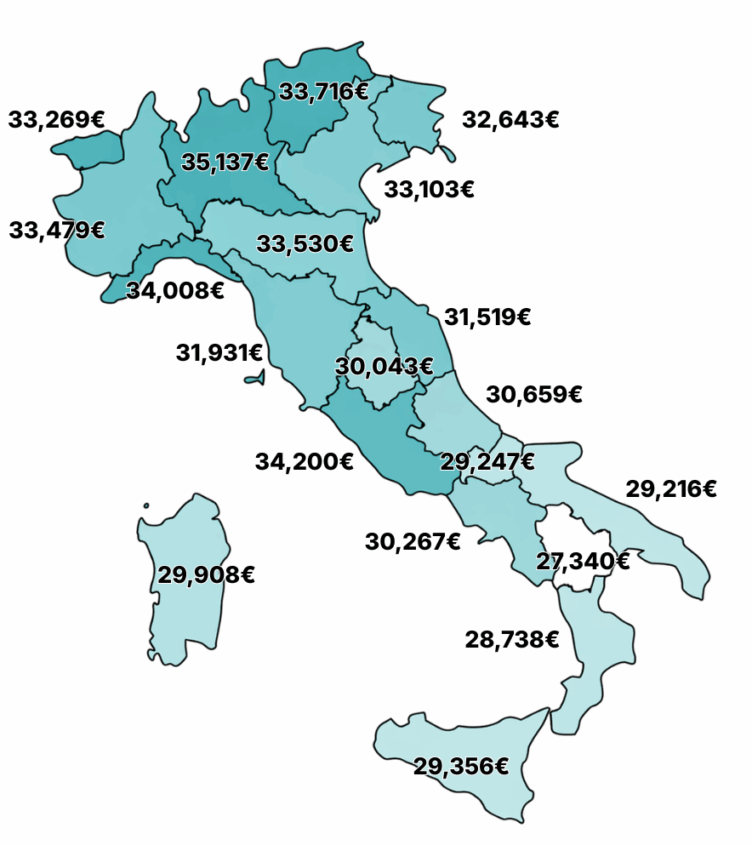
Data source: Osservatorio JobPricing – Salary Outlook
Data processing and visualisation by Europass Srl
This map shows a clear pattern:
- Northern regions tend to have higher salaries
- Central regions have slightly lower salaries
- Southern regions have the lowest averages
In large cities such as Milan or Bologna, average net salaries are often slightly above €2,000 per month, while Rome tends to be slightly lower. These are general figures that vary depending on the job and experience, but they help explain the overall structure.
For students, however, the most relevant question is usually not the salary of a full-time job, but the part-time earning potential and whether that income can offset a significant part of monthly costs.
Working with a study residence permit
If you are a non-EU student, you can work up to 20 hours per week while studying in Italy.
This is a key advantage because it allows you to:
- earn money while studying
- gain local work experience
- improve your Italian in real-life situations
In most typical student jobs, such as hospitality, retail, cafés and customer service, you can expect around €7 to €10 per hour, depending on the role and the city. This usually translates into €500 – €900 per month if you work part-time regularly.
This matters because it makes the overall project more sustainable. The value is not only financial. It is also psychological. Earning part of your own costs often changes the way you feel about being independent and settled in a new country.
Finding a job: what to expect

Finding a part-time job in Italy mainly depends on your level of Italian and the city where you live.
In general, even a basic level of Italian will greatly increase your chances. Moving from beginner level to B1 or B2 can open up many more opportunities, especially in customer-facing roles.
For most international students, the easiest entry points are:
- cafés and restaurants
- hotels and tourism-related jobs
- retail and customer service
This is where the choice of city becomes very important: cities such as Milan offer more corporate opportunities, but they are also more competitive and expensive. Smaller cities can be cheaper, but they offer fewer job options.
Florence stands out as one of the most balanced choices. It is not only a cultural city, but also one of Italy’s most important tourism centers. This creates constant demand for part-time roles, especially in hospitality and service jobs.
The goal is not to maximize your salary immediately. The goal is to build a sustainable path in Italy, where you can study, work part-time, improve your language skills and gradually expand your opportunities.
Work and study in Italy with Europass
Living in Italy as an international student is often more affordable than in countries such as the United States or the United Kingdom, but the real cost will depend on your choices, especially where you live and how you manage rent.
The key point is simple: Italy can be financially sustainable if you plan carefully and combine studying with part-time work.
If you are looking for a structured way to do this, you can explore our Work & Study Programme in Florence, designed to help you study Italian, work part-time and build a realistic path to living in Italy.
FAQ
Is Italy expensive for international students?
Italy can be manageable for international students, but the answer depends heavily on the city, accommodation choice, and lifestyle. Rent is usually the most important factor in the budget.
What is the average cost of living in Italy for a student?
A student budget often depends on whether accommodation is shared or private, but the most common monthly categories include rent, groceries, transport, utilities and personal expenses.
Which Italian city is cheaper for students: Milan or Florence?
In general, Milan tends to be more expensive, especially for rent, while Florence often feels more manageable for many students.
Can students work in Italy while studying?
Yes. Eligible students can work up to 20 hours per week, or up to 1,040 hours per year.
Can part-time work cover the cost of living in Italy?
Usually, part-time work helps cover part of the budget rather than all of it. It can often support groceries, transport, small bills and part of the rent, especially in shared accommodation.
Why does Florence make sense for working and studying?
Florence offers a strong combination of cultural immersion, walkability and tourism-related part-time opportunities, which can make it especially strategic for students who combine language study and work.